Portfolio Risk
Measure potential portfolio losses (Value at Risk) across thousands of return scenarios
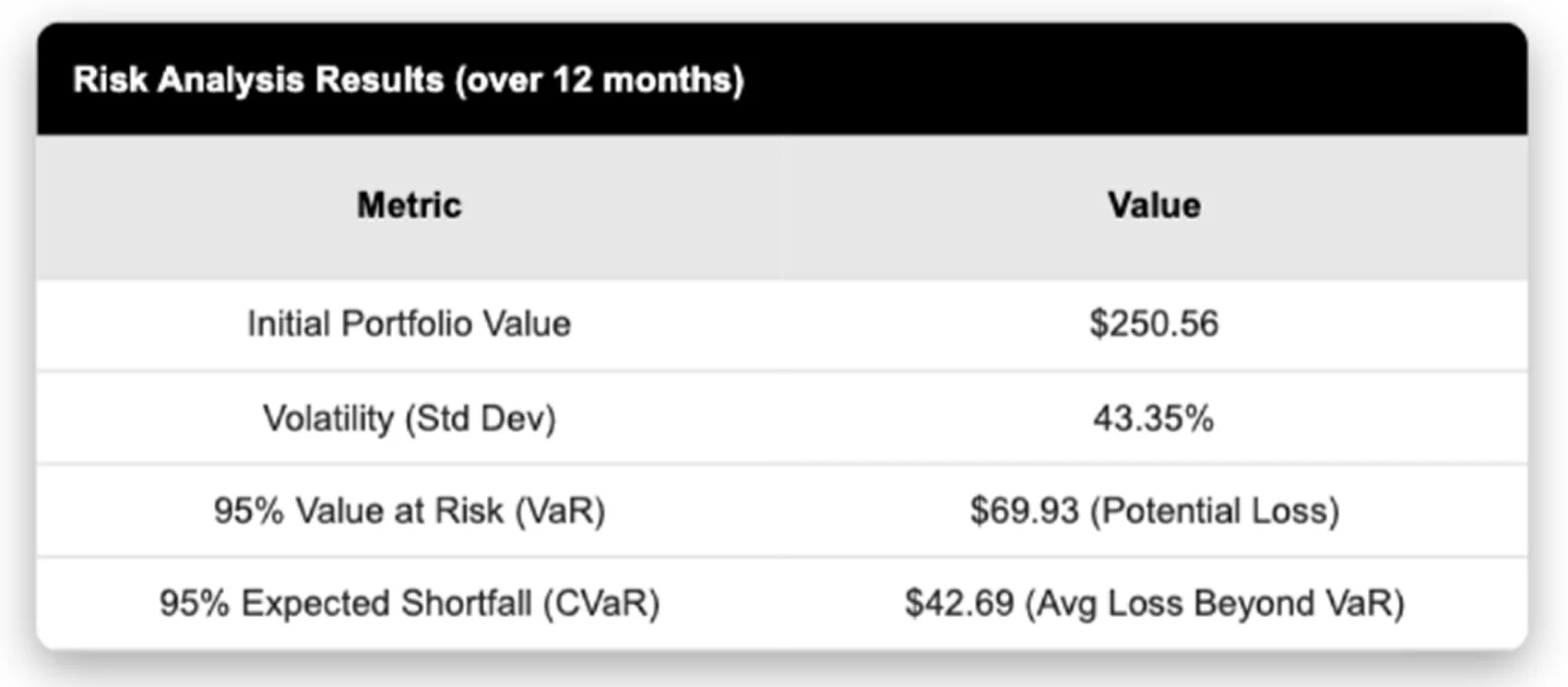
A simulation that measures the risk and potential loss of a portfolio of assets over a defined time horizon. It uses historical price data to simulate thousands of future return scenarios and calculates how much you could lose in the worst cases — quantified as Value at Risk (VaR).
Answer the question: "If market conditions turn bad, how much of my portfolio value could I lose — and what's the probability of that happening?"
Data — What data do you need
| Field | Power BI field / example | Description |
|---|---|---|
| Asset | AAPL, AMZN, GOOGL, MSFT, TSLA | The name or ticker of each asset in the portfolio. |
| Date | Historical price dates | Used to calculate historical returns over time. |
| Price | Sum of Price | The asset price at each date — the model computes daily/period returns from this field. |
Use Case — VaR Analysis for a 5-Asset Tech Portfolio
Scenario: A portfolio manager holds 5 tech stocks. They want to quantify how much the portfolio could lose in a bad month — at the 5% and 1% confidence levels — to set appropriate risk limits and capital reserves.
Configuration:
- ▸Problem Type: Portfolio Risk
- ▸Asset: Ticker symbol (AAPL, AMZN, GOOGL, MSFT, TSLA)
- ▸Date: PriceDate (historical price dates)
- ▸Price: Sum of Price
Sample output — VaR and Expected Shortfall per asset and portfolio:
| Asset | Portfolio Weight | Expected Return | VaR (5%) | VaR (1%) | Max Loss |
|---|---|---|---|---|---|
| AAPL | 22% | +1.8% | -4.2% | -7.1% | -18.3% |
| AMZN | 18% | +2.1% | -5.6% | -9.3% | -24.7% |
| GOOGL | 20% | +1.6% | -4.8% | -8.0% | -21.2% |
| MSFT | 25% | +1.4% | -3.9% | -6.4% | -16.8% |
| TSLA | 15% | +3.2% | -9.4% | -15.8% | -41.3% |
| Portfolio | 100% | +1.9% | -3.8% | -6.2% | -15.4% |