Demand Forecasting
Predict future product demand with seasonal detection and optimal inventory calculation
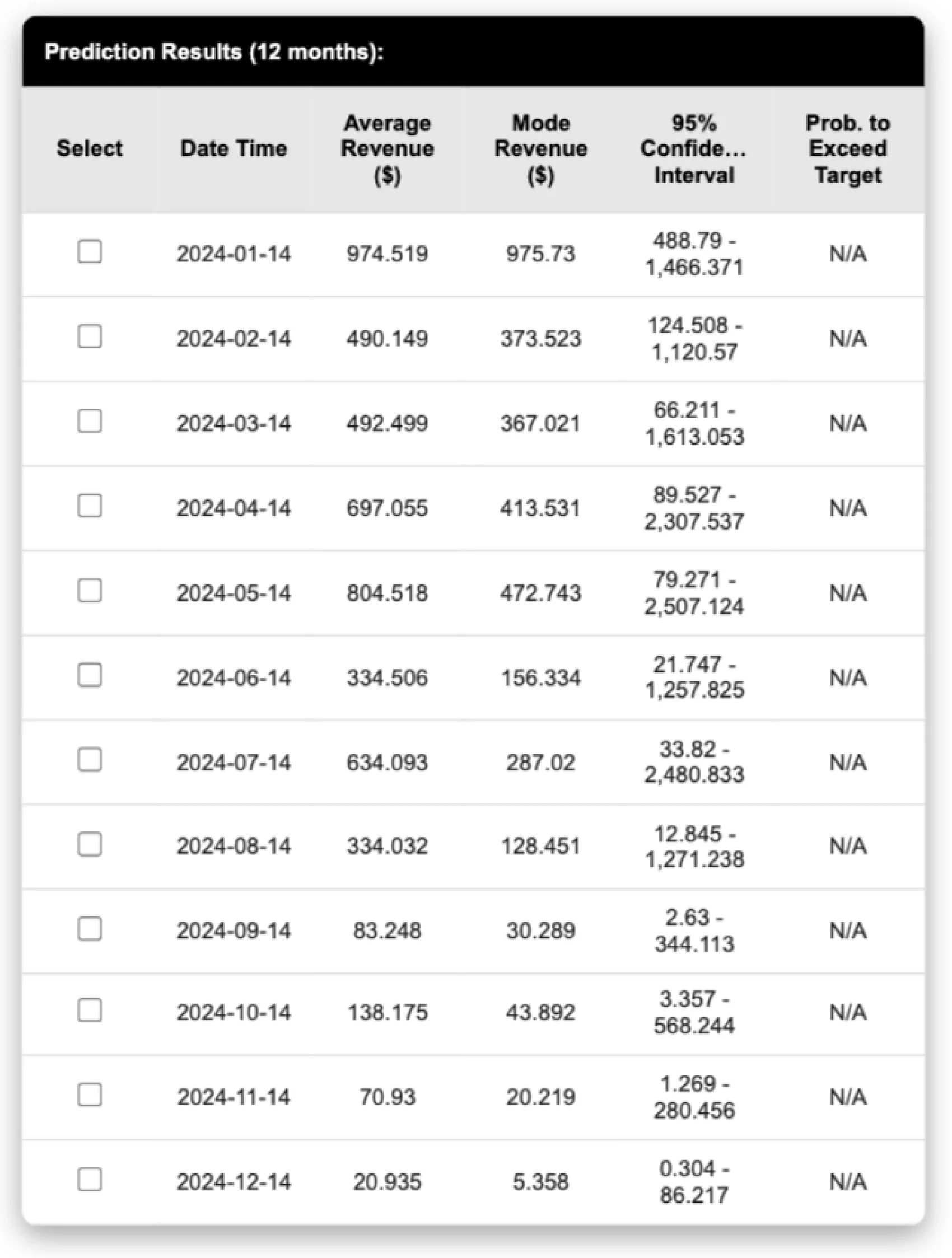
A simulation that predicts future product demand by learning from historical sales or order data. It automatically detects seasonal patterns in your data and runs 10,000 scenarios to give you a demand range — not just a single number. It also calculates the optimal inventory level needed to meet demand at your target service level.
Answer the question: "How much of this product will customers need next period — and how much stock should we hold to avoid running out?"
Data — What data do you need
| Field | Power BI field / example | Description |
|---|---|---|
| Product / SKU | Project, Product, SKU | Identifies what is being forecasted — used to produce one forecast row per entity. |
| Date | Historical demand dates | The time axis of historical demand data — used for seasonal pattern detection. |
| Demand Quantity | Sum of Demand | Actual historical demand or sales volume — the model learns the distribution from this field. |
Use Case — Inventory Planning for 5 Projects / SKUs
Scenario: A supply chain planner needs to set safety stock levels for the next quarter. They have 2 years of historical weekly demand data per project. The goal is to get a P10/P50/P90 demand forecast for each project and calculate the inventory buffer needed to achieve 95% service level.
Configuration:
- ▸Problem Type: Demand Forecasting
- ▸Product / SKU: ProjectName
- ▸Date: OrderDate
- ▸Demand Quantity: Sum of Demand
Sample output — Demand forecast per project across 4 future periods:
| Project | Dec 15, 2023 | Sep 15, 2023 | May 15, 2023 | Apr 15, 2023 |
|---|---|---|---|---|
| Project Alpha | 380 | 0 | 0 | 410 |
| Project Beta | 420 | 0 | 240 | 220 |
| Project Delta | 0 | 0 | 0 | 0 |
| Project Gamma | 530 | 0 | 0 | 0 |
| Total | 2.52K | 2.02K | 1.99K | 1.95K |