
PetroChina Global Energy: Oil Production Report – Key Insights (1991–2024)
839 Downloads
Description
Overall Production Summary
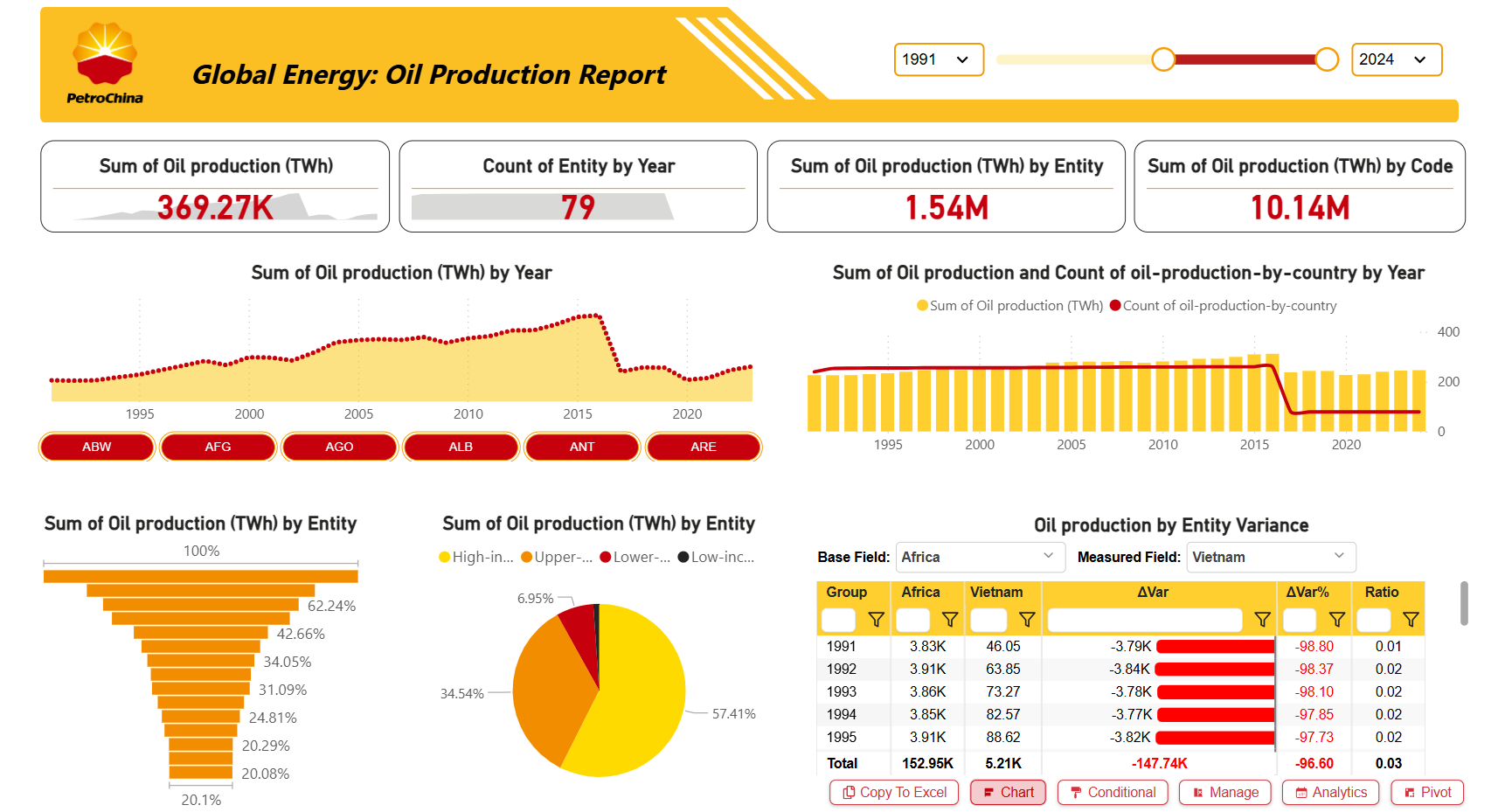
- Total Oil Production: 369.27K TWh across the dataset, with an average of 79 entities (countries) reporting per year.
- Per-Entity Production: Average 1.54M TWh per entity over the period.
- Per-Code Production: 10.14M TWh (likely ISO country codes), indicating aggregated global output.
Temporal Trends
- Annual Production Growth: Oil production steadily increased from ~3K TWh in 1991 to a peak of ~4K TWh around 2015–2018, followed by a gradual decline to ~3.5K TWh by 2024. This suggests a post-peak oil era influenced by factors like OPEC cuts, geopolitical events (e.g., 2014 oil price crash), and energy transitions.
- Country Participation: The count of oil-producing countries remained stable at 80–90 throughout, with a slight dip in recent years – implying consolidation among major producers rather than new entrants.
- Variance Example (Africa vs. Vietnam): Africa's production was consistently higher (3.8K–3.9K TWh annually from 1991–1995) compared to Vietnam's (46–86 TWh), with Vietnam underperforming by 97–99% each year. This highlights regional disparities, with Africa as a stable mid-tier producer and Vietnam as a minor player.
Entity (Country) Distribution
- Top Producers Dominance: The top entity accounts for 62.24% of total production, followed by 46.65% and 42.66% – showing extreme concentration among a few superpowers (likely USA, Saudi Arabia, Russia).
- Income Level Breakdown:
- Upper Middle Income: 57.41% (dominant group, e.g., China, Russia).
- High Income: 34.54% (e.g., USA, Norway).
- Lower Middle Income: 8.05% (e.g., India, Nigeria).
- Low Income: Negligible. → Production is heavily skewed toward wealthier/developing economies with infrastructure advantages.
Key Takeaways
- Peak and Decline: Global oil output peaked mid-2010s, with a ~12–15% drop since, signaling supply constraints, demand shifts to renewables, and efficiency gains.
- Concentration Risks: ~80% of production from top 3–5 entities and upper/high-income groups – vulnerable to geopolitical risks (e.g., Middle East conflicts) or policy changes.
- Stability in Participation: Consistent ~80 countries producing oil, but output per country varies widely, with emerging markets like Vietnam lagging far behind established regions like Africa.
Recommendations
- Diversify Supply Sources: PetroChina should invest in partnerships with lower-middle income entities (e.g., Vietnam-like markets) to mitigate risks from over-reliance on top producers. Explore joint ventures or tech transfers to boost their output by 20–30% over 5 years.
- Transition to Renewables: Given the post-2015 decline, accelerate R&D in green energy (e.g., solar, hydrogen) to offset oil's shrinking share. Target a 15% portfolio shift by 2030 to align with global net-zero goals.
- Efficiency and Monitoring: Use AI-driven analytics to forecast variances (like Africa-Vietnam gaps) and optimize production. Recommend quarterly reviews to identify underperformers and allocate resources for a 5–10% efficiency gain.
- Geopolitical Hedging: Focus on stable regions (e.g., Africa) for new explorations, while lobbying for policies in high-income areas to sustain demand amid EV/renewable transitions.
- Data Enhancement: Unlock full dashboard features (e.g., via license key) for deeper entity-level insights, and integrate real-time 2025 data to track ongoing declines.
The dashboard is designed using Flexa Design, Flexa Tables, and Flexa Charts from Flexa Intel.
Reviews
No reviews yet — be the first to review this template.
Other Templates
Free Operations & Production
Free Operations & Production
Free Sales & Revenue
If you find this website helpful, share it with friends and colleagues to boost their Power BI skills and work efficiency!
Like this site? Share it