
Intel Storage Cost Trends Dashboard – Key Insights (1956–2023)
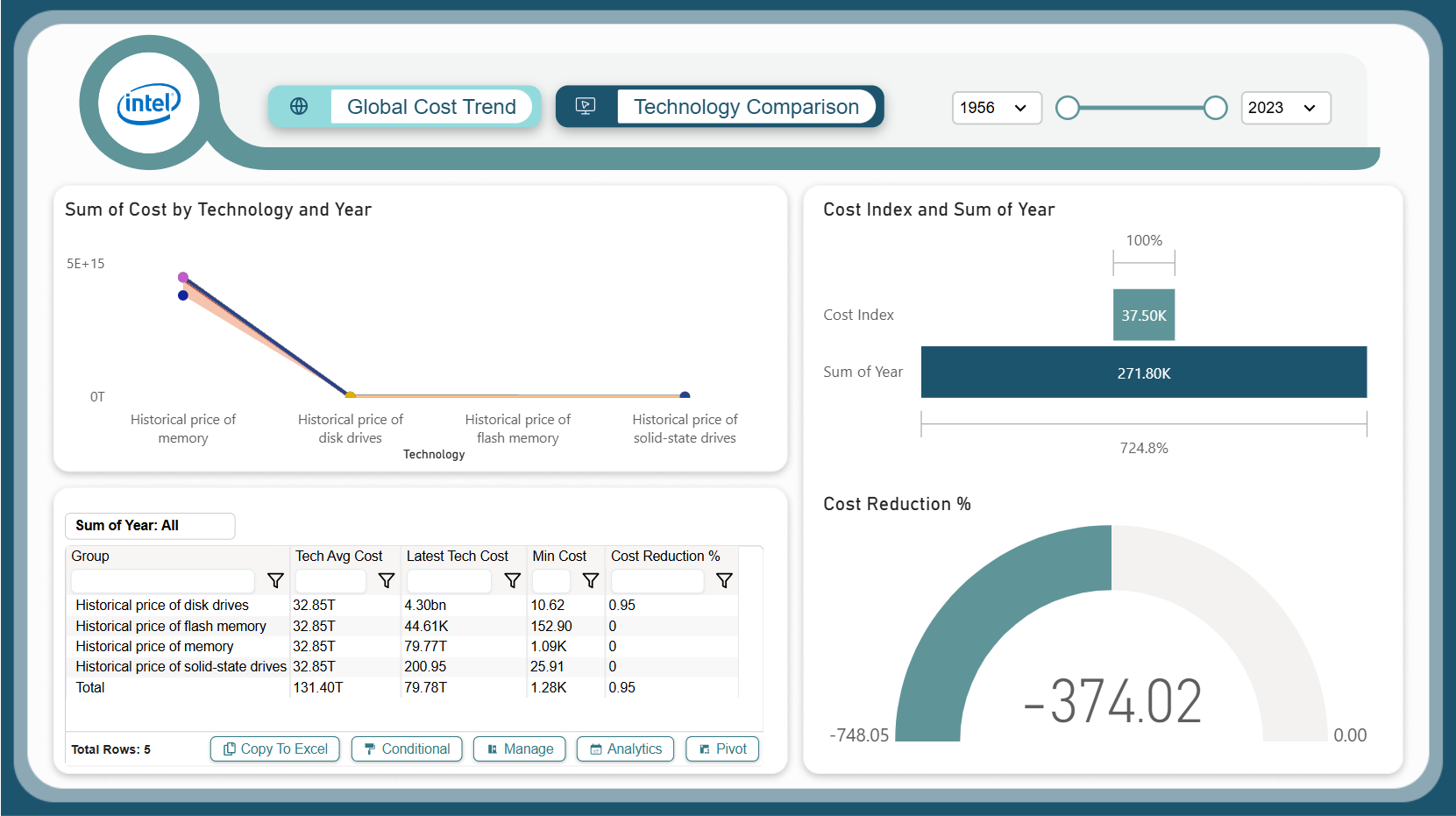
Overall Cost Reduction
- Cost Index: 37.50K (significant decline from historical baseline)
- Sum of Year: 271.80K (cumulative years or normalized metric)
- Cost Reduction %: -374.02% (massive historical drop, indicating orders-of-magnitude price decline over time)
Historical Cost by Technology
| Technology | Tech Avg Cost | Latest Tech Cost | Min Cost | Cost Reduction % |
| Historical price of disk drives | 32.85T | 4.30bn | 10.62 | 0.95 |
| Historical price of flash memory | 32.85T | 44.61K | 152.90 | 0 |
| Historical price of memory | 32.85T | 79.77T | 1.09K | 0 |
| Historical price of solid-state drives | 32.85T | 200.95 | 25.91 | 0 |
| Total | 131.40T | 79.78T | 1.28K | 0.95 |
→ All technologies started from extremely high average costs (trillions) and have collapsed to modern lows, with disk drives showing the most dramatic reduction.Trend Over Time
- Sharp exponential decline in cost per unit (likely per GB or similar capacity metric) from 1956 onward.
- Steepest drops in early eras (memory/disk drives), transitioning to flatter but still declining curve for flash and SSDs in recent decades.
- The line chart illustrates classic "learning curve" effect in semiconductor and storage industries.
Key Takeaways
- Moore's Law in Action: Storage costs have fallen by orders of magnitude (>99.999% reduction) over 67 years, enabling explosive growth in data storage, cloud computing, and consumer devices.
- Disk Drives Lead Decline: Traditional HDDs show the highest historical cost reduction (0.95%), reflecting mature technology with massive economies of scale.
- Flash/SSD Revolution: More recent technologies (flash memory, SSDs) started later but continue rapid price drops, driving modern computing shifts from mechanical to solid-state storage.
- Ongoing Deflation: Even latest costs (e.g., SSDs at ~$200) are trending downward, with no signs of bottoming out yet.
Recommendations
- Leverage continued cost declines to accelerate data-intensive initiatives (AI training, cloud expansion, edge computing).
- Shift infrastructure investments toward SSD/flash-based solutions as HDD economics become less competitive.
- Plan for abundance: Assume near-zero marginal storage cost in long-term forecasting for product design and capacity planning.
- Monitor NAND flash supply chain risks (highly concentrated in few manufacturers) despite favorable price trend.
Overall: Dramatic, multi-decade deflation in storage costs — led initially by disk drives and now by flash/SSDs — has been one of technology's most transformative economic trends, enabling the data explosion of the digital age. The trend remains strongly downward with no reversal in sight.
Reviews
No reviews yet — be the first to review this template.
Other Templates

If you find this website helpful, share it with friends and colleagues to boost their Power BI skills and work efficiency!
Like this site? Share it