
IBERDROLA Distribution of Renewable Energy Generation Dashboard – Key Insights (2005–2024)
981 Downloads
Description
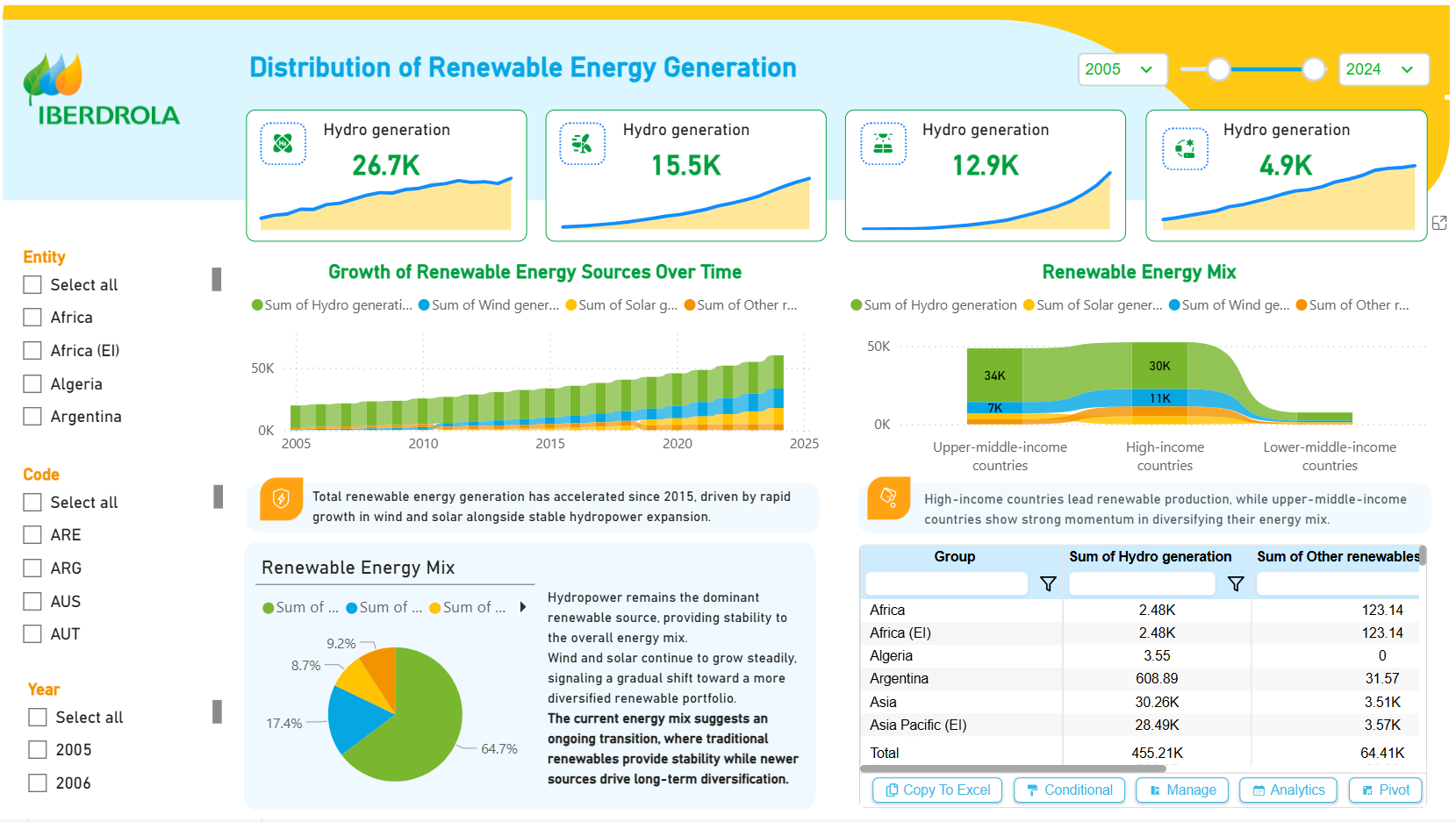
Overall Capacity Breakdown (2024)
- Hydro generation: 26.7K (dominant)
- Wind generation: 15.5K
- Solar generation: 12.9K
- Other generation: 4.9K
- Total: ~60K (likely GW)
Renewable Energy Mix
- Hydro: 64.7% (clear majority, providing baseload stability)
- Wind: 17.4%
- Solar: 8.7%
- Other: 9.2% → Hydro remains the cornerstone, but wind and solar together now represent ~26%, showing meaningful diversification.
Growth Trend Over Time
- Strong, consistent growth since 2005, with acceleration post-2015.
- Hydro (green) historically led and continues steady expansion.
- Wind (blue) and solar (orange) exhibit rapid growth, especially after 2015 – driving the recent surge in total capacity.
- Insight note: "Total renewable energy generation has accelerated since 2015, driven by rapid growth in wind and solar alongside stable hydropower expansion."
Income Group Distribution
- Upper-middle-income countries: 34K (largest block)
- High-income countries: 30K
- Lower-middle-income countries: 11K
- Unspecified/Other: 7K → Upper-middle-income nations (e.g., China, Brazil) lead total capacity, while high-income countries show strong momentum in diversifying their mix.
Regional Highlights (from Table)
- Asia Pacific: Significant hydro (28.5K–30.3K) and other renewables (3.5K).
- Africa: Hydro-focused (~2.5K).
- Argentina: Notable hydro (608K) and other (31.6K). → Hydro dominance is particularly pronounced in developing/emerging regions.
Key Takeaways
- Hydro Stability + New Sources Growth: Hydropower provides the reliable foundation (65% share), while wind and solar are the primary growth engines post-2015 – classic pattern of transitioning to a more diversified, scalable portfolio.
- Emerging Market Leadership: Upper-middle-income countries contribute the most capacity, reflecting massive hydro builds in Asia/Latin America and rapid wind/solar scale-up.
- Ongoing Diversification: The gradual shift from hydro-heavy to inclusion of variable renewables signals long-term resilience and alignment with global decarbonization trends.
- Regional Specialization: Hydro remains critical in water-rich emerging regions; wind/solar gains are more evenly spread.
Recommendations
- Maintain hydro assets for baseload reliability while aggressively scaling wind and solar to further reduce portfolio risk and capture cost declines.
- Prioritize projects in upper-middle-income markets (Asia Pacific, Latin America) for highest growth impact.
- Invest in storage and grid flexibility to integrate higher shares of variable wind/solar without compromising the stability hydro currently provides.
- Leverage high-income country expertise in wind/solar technology for partnerships in emerging markets.
Overall: Robust, hydro-anchored renewable growth with accelerating diversification driven by wind and solar – well-positioned for continued expansion, especially in upper-middle-income regions, while gradually building a more balanced and resilient energy mix.
Reviews
No reviews yet — be the first to review this template.
Other Templates
Free Operations & Production
Free Sales & Revenue
$10Supply Chain & Logistics
If you find this website helpful, share it with friends and colleagues to boost their Power BI skills and work efficiency!
Like this site? Share it