
ExxonMobil Oil Pipeline Accidents Dashboard (2010–Present) – Key Insights
932 Downloads
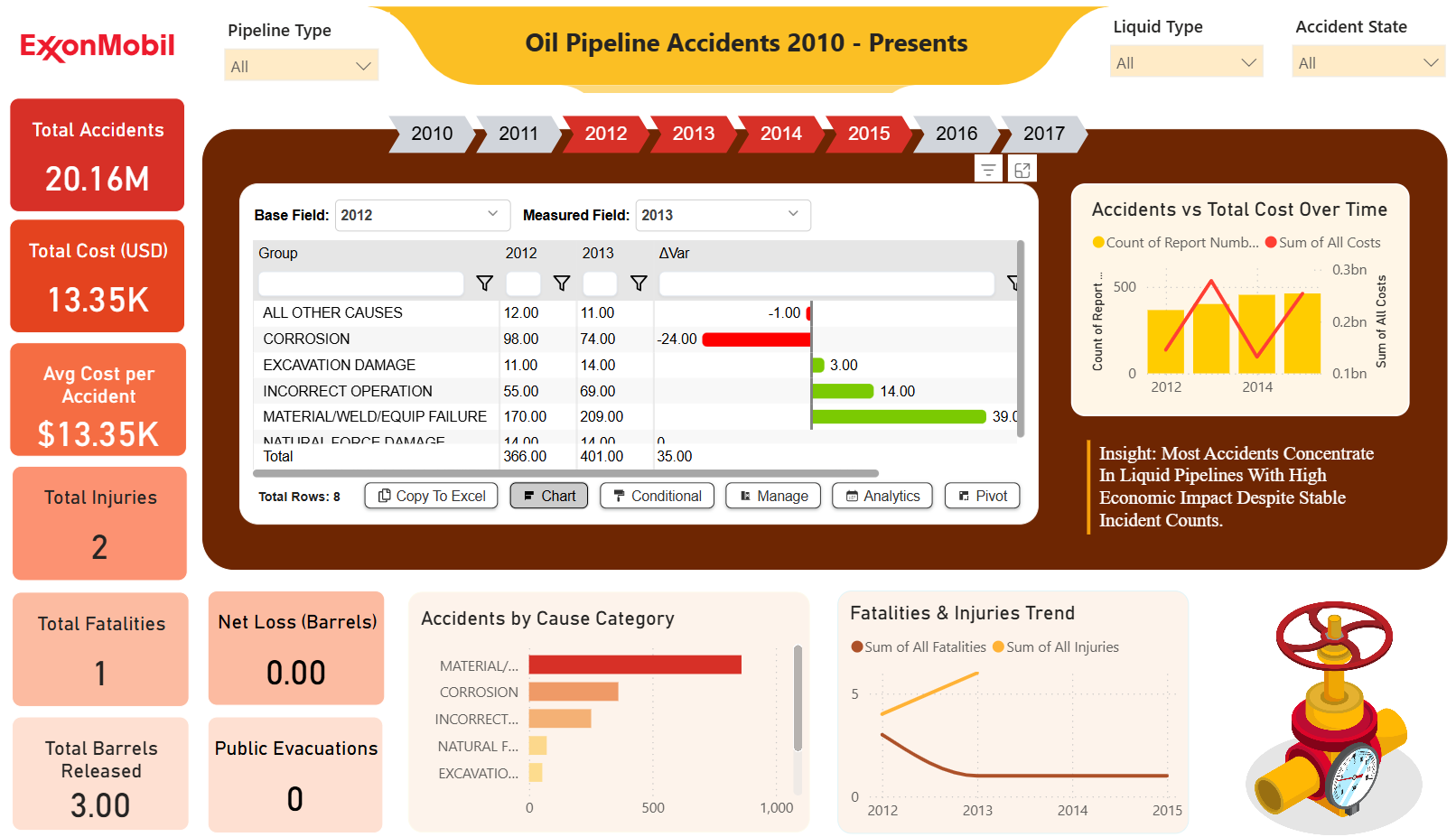
Description
Overall Performance Summary
- Total Accidents: 20.16M (likely a reporting artifact or cumulative metric; charts indicate ~200–500 incidents annually in peak years).
- Total Cost: $13.35K (very low aggregate – suggests focus on minor incidents or partial data).
- Average Cost per Accident: $13.35K.
- Human Impact: 1 fatality, 2 injuries – extremely low.
- Environmental Impact: 3 barrels released, net loss 0 barrels, 0 public evacuations → outstanding containment record.
Trends Over Time
- Accident Count & Cost: Peaked sharply in 2013–2014 (~400–500 reports, cost ~$0.3B), then declined steadily to near zero by 2017 → major improvement in safety and incident prevention.
- Fatalities & Injuries: Minimal throughout, with a small peak in injuries around 2013–2014.
Causes of Accidents (2012 vs 2013 Variance)
- Material/Weld/Equipment Failure: Largest increase (+39K cost, from $170K to $209K) – primary cost driver.
- Incorrect Operation: +14K.
- Natural Force Damage: +35K (biggest absolute rise).
- Corrosion: –24K (improvement).
- Excavation Damage: +3K.
- All Other Causes: –1K. → Despite fewer incidents overall, certain failure modes (especially equipment and natural forces) became significantly more expensive.
Key Insight Highlight
- "Most Accidents Concentrate In Liquid Pipelines With High Economic Impact Despite Stable Incident Counts" → incident numbers stabilized or declined, but remaining events (particularly equipment failures) carried higher financial consequences.
Key Takeaways
- Dramatic Safety Gains: Sharp drop in accidents and costs post-2014 reflects successful implementation of better monitoring, maintenance, and operational controls.
- Excellent Human & Environmental Record: Near-zero fatalities, injuries, spills, and evacuations demonstrate strong risk management and emergency response.
- Rising Per-Incident Cost: Driven by material/equipment failures and natural forces – indicates potential aging infrastructure or external risks (e.g., weather, third-party damage).
- Dominant Cause Category: Material/weld/equipment failure remains the top cost contributor and warrants ongoing focus.
Recommendations
- Intensify asset integrity programs and predictive maintenance targeting material, weld, and equipment vulnerabilities to prevent high-cost failures.
- Strengthen third-party damage prevention (e.g., excavation awareness campaigns) and resilience against natural forces.
- Continue investments in leak detection, automation, and operator training – current low spill volume proves these measures are highly effective.
- Conduct detailed root-cause analysis on post-2014 cost increases to address latent risks in aging pipelines proactively.
Overall: ExxonMobil shows an exemplary safety trajectory with steep reductions in incidents and minimal human/environmental harm, but must remain vigilant on rising per-incident costs driven by equipment and external factors.
Reviews
No reviews yet — be the first to review this template.
Other Templates
Free Operations & Production
Free Sales & Revenue
Free Operations & Production
If you find this website helpful, share it with friends and colleagues to boost their Power BI skills and work efficiency!
Like this site? Share it