
BP Oil Pipeline Accidents: Key Patterns (2010–Present) – Key Insights
876 Downloads
Description
Overall Summary
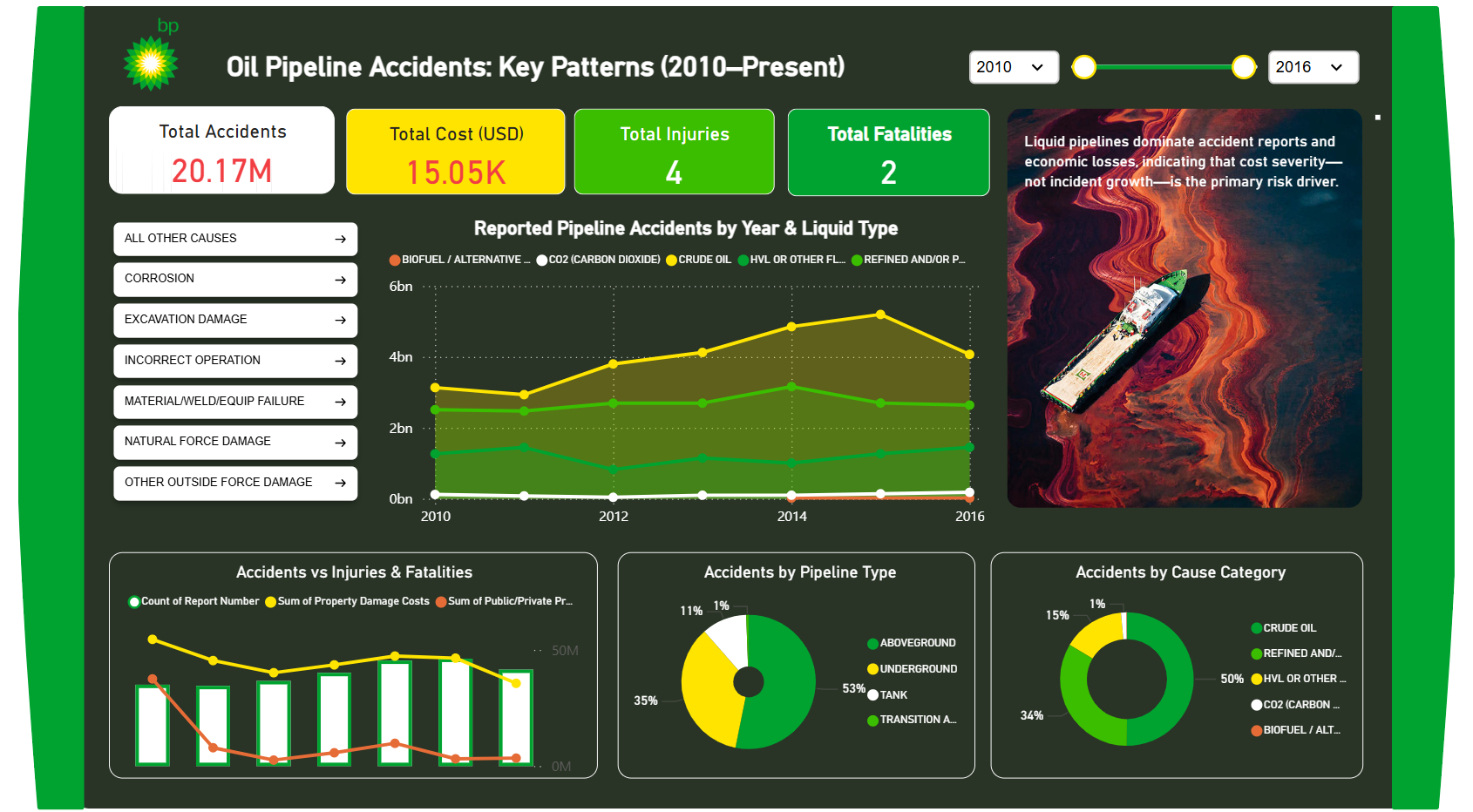
- Total Accidents: 20.17M (likely cumulative reported events or metric artifact; charts show volume in billions of units, possibly related to volume transported or incident reports).
- Total Cost: $15.05K (low aggregate – suggests minor incidents dominate).
- Human Impact: 4 injuries, 2 fatalities – very low.
- Key Insight: "Liquid pipelines dominate accident reports and economic losses, indicating that cost severity—not incident growth—is the primary risk driver."
Reported Accidents by Year & Liquid Type
- Refined and/or Petroleum Product (green) is the dominant category, peaking mid-period (~4–5bn units).
- HVL or Other Flammable/Toxic Fluid, Gas (yellow line) shows steady growth.
- Crude Oil (light green) and others remain lower.
- Total volume grew steadily from 2010, peaked around 2014–2015, then slightly declined.
Accidents by Pipeline Type
- Tank: 53% (largest share)
- Underground: 35%
- Aboveground: 11%
- Transition Area: 1% → Storage tanks and underground lines account for ~88% of incidents.
Accidents by Cause Category
- Refined and/or Petroleum Product: 50%
- HVL or Other Flammable/Toxic: 34%
- Crude Oil: 15%
- CO2 and Biofuel/Alternative: ~1% → Refined products in tanks/underground pose the majority risk.
Accidents vs Injuries & Fatalities
- Incident/property damage costs (yellow) peaked mid-period then declined.
- Public/private property costs (red) and report counts (green bars) followed similar pattern.
- Injuries/fatalities remained negligible throughout.
Key Takeaways
- Liquid Dominance: Refined petroleum products drive both volume and economic impact – focus prevention here.
- Cost Severity Over Volume Growth: While incident volume stabilized post-2015, severity (cost per event) is the ongoing risk – likely due to larger/more complex failures in remaining incidents.
- Tank & Underground Vulnerability: Over 88% of accidents occur in tanks and buried lines – harder to inspect and detect.
- Excellent Human Safety: Extremely low injuries (4) and fatalities (2) reflect strong safety culture, emergency response, and containment.
- Mid-Period Peak: Highest risk period was 2013–2015; subsequent decline suggests successful interventions (better monitoring, maintenance).
Recommendations
- Prioritize tank integrity programs and underground pipeline inspection technologies (e.g., smart pigs, leak detection).
- Focus risk mitigation on refined product handling and storage – the clear dominant category.
- Maintain investments in operator training, emergency response, and third-party damage prevention to preserve the outstanding human safety record.
- Analyze root causes of mid-period peak to ensure lessons are sustained and applied to prevent resurgence.
Overall: bp demonstrates strong progress in reducing incident volume and maintaining minimal human impact, with liquid (especially refined) products in tanks and underground pipelines as the primary ongoing economic risk – cost severity in remaining events requires continued vigilance on asset integrity.
Reviews
No reviews yet — be the first to review this template.
Other Templates
Free Sales & Revenue
$10Operations & Production
Free Sales & Revenue
If you find this website helpful, share it with friends and colleagues to boost their Power BI skills and work efficiency!
Like this site? Share it